PC Express Service Redesign: From Missing Items to Trusted Delivery
Client
Loblaw
Year
2024
As part of a Service Design project, our team explored a hypothetical redesign of the PC Express pickup and delivery experience. We focused on key pain points such as missing items, low-stock uncertainty, and unclear issue reporting, proposing transparency-led improvements to strengthen trust and operational accountability.
Scope of Work
Branding
Service Design
UX Research
Filming
PC Express is built for convenience.
How might we prevent the loss of items while establishing transparency and trust in PC Express?
Customer Experience
We started by becoming customers ourselves and by collecting real feedback from people who use PC Express. The stories were consistent: missing items with no explanation, out-of-stock surprises, and no clear in-app path to report problems.
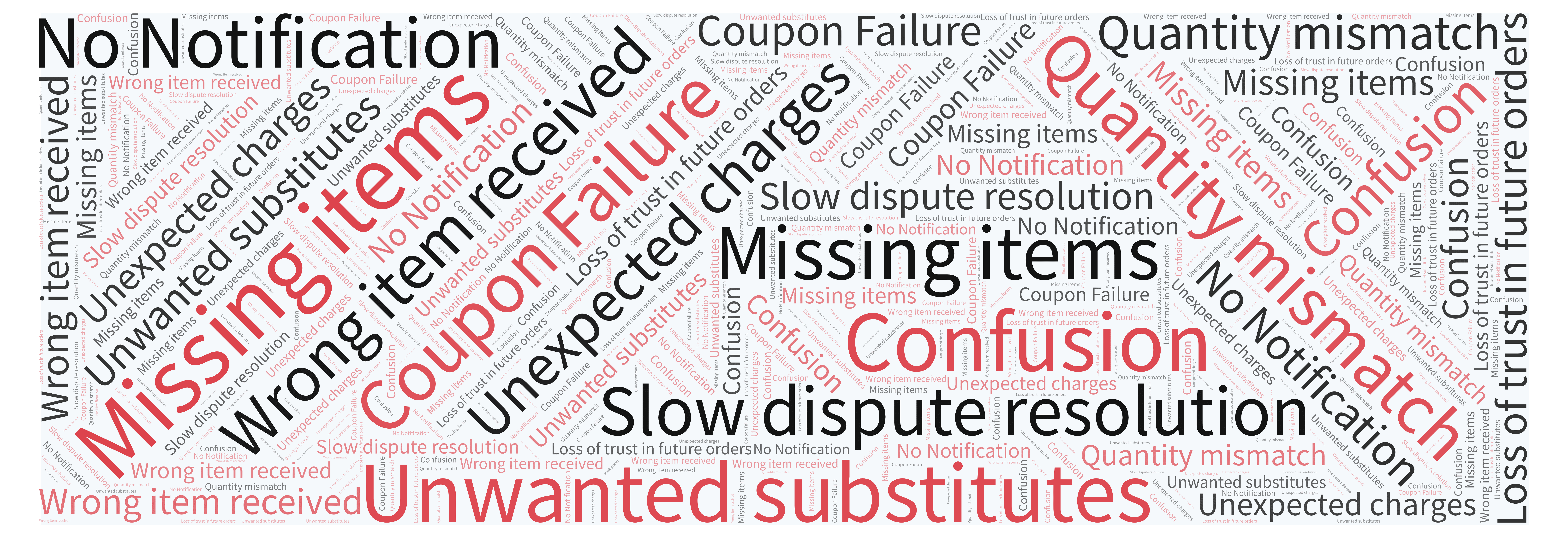
To broaden our evidence base, we also crawled 2,237 negative user feedback from the App Store and Google Play, then translated recurring complaints into a pain-point word cloud to capture what users struggle with most.
The problem isn’t just customer-side
At first, it looked like a customer experience issue.
But the deeper we looked, the clearer it became: this problem was multisided.
To validate what we were seeing, we spoke with members of the PC Express UX team at Loblaw. Their perspective helped us surface operational pain points behind the scenes, especially around shift handoffs, duplicated picking, and missing-item accountability.
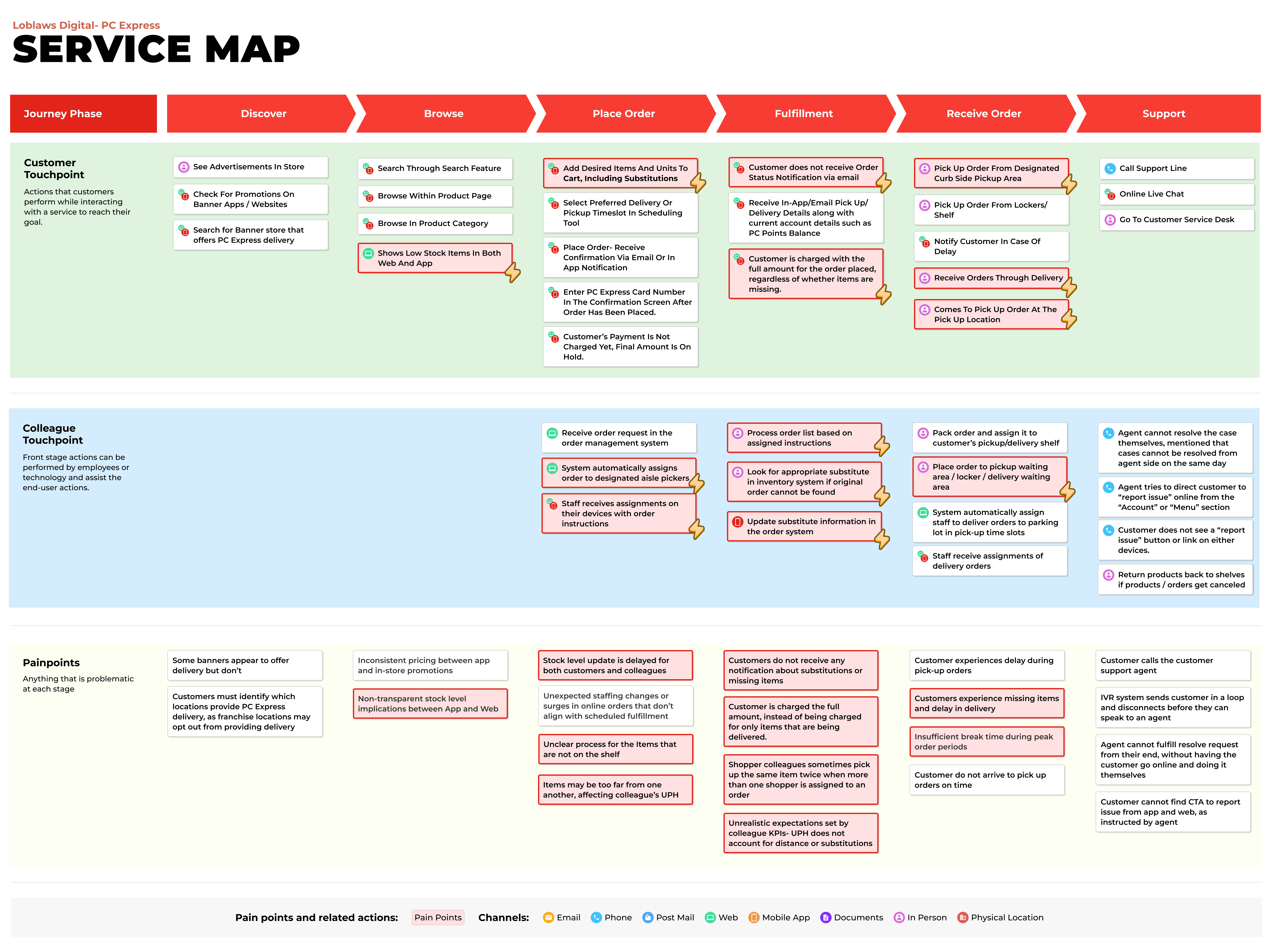
We analyzed customer and colleague workflows, then synthesized key pain points into a PC Express Service Map to capture the service journey from discovery to support.
We’ve marked the areas of friction in red and highlighted them in yellow for easy reference.
Metrics that matter
We learned from the Loblaw team's interview that PC Express tracks two key metrics: Perfect Order and OSAT.
Perfect Order measures order accuracy and issue-free deliveries, but can unfairly penalize colleagues for out-of-stock items beyond their control.
OSAT reflects overall satisfaction, where key pain points include missing items, limited order status notifications, and inconsistent support.
Our goal is to improve accuracy and transparency while keeping the process fair for teams.

Small Changes. Real Impact.
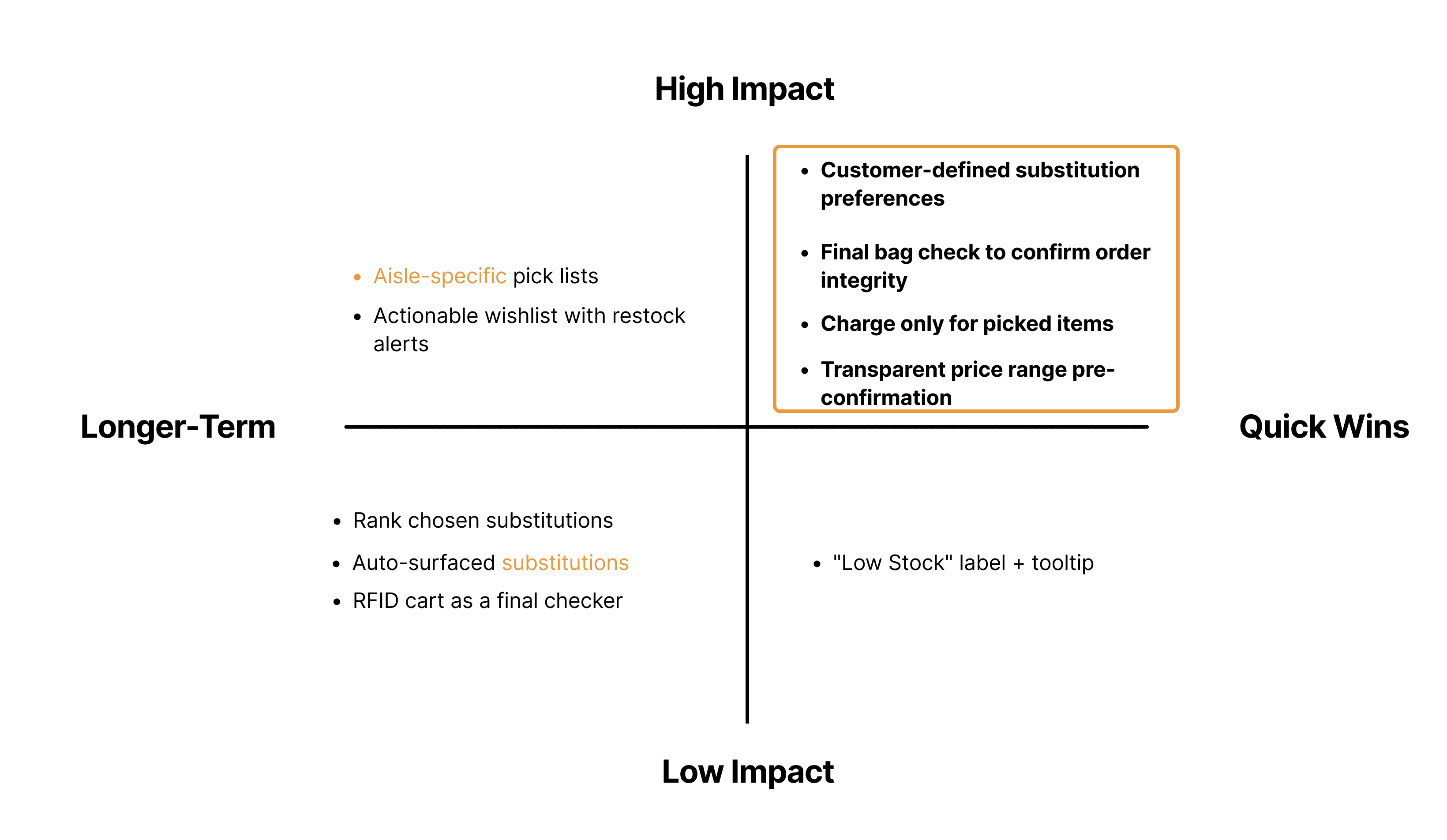
To make it easier for the team, we decided to prioritize some quick wins for PC Express. Something that you could do in the shortest possible time based on resources we think you may have available:
Customer-Defined Substitutions:
Let customers choose their preferred substitutions during the shopping experience instead of doing it in the cart.Final Bag Check:
A colleague can quickly review the bag before delivery to catch missing or incorrect items.Charge Only for Picked Items:
Build trust by ensuring customers only pay for what they actually receive.Transparent Price Range:
Show an estimated range at checkout based on substitutions picked, so customers know what to expect if substitutions happen.
To address this, we introduced several optimizations across both the customer- and colleague-side experiences.
Customer Optimization 1: Transparency
To improve transparency on the customer side, we redesigned stock labels to clearly distinguish regular, low-stock, and out-of-stock states.
We also encouraged users to save unavailable items in a Restock Wishlist, and prompted substitutions when inventory runs low to reduce uncertainty before checkout.
For example, A customer browsing Strawberry Jam can instantly see it is Low Stock, receive a prompt to select substitutions, and if an item becomes Out of Stock, they can save it to the Restock Wishlist for future restock alerts.
Customer Optimization 2: Customizable Substitution & Final Price Range
To reduce uncertainty around substitutions, we introduced a customizable preference flow for low-stock items.
Customers can select up to 3 ranked substitutes using keywords, and view an estimated final price range at checkout, improving transparency and preventing unexpected charges.
Colleague Optimization 1: Dynamic Synchronized Order Picking
On the colleague side, we’re streamlining the picking process with a dynamic, synchronized picking list. Order tabs enable multitasking, while real-time status updates ensure seamless progress tracking. Staff can also save their progress, making collaboration smoother and more efficient.
Colleague Optimization 2: Order Fulfillment Validation
Following that, accountability is built through an order fulfillment checklist before handing off the orders.
This process ensures that every item in order is properly addressed, reinforcing trust and consistency.
Bringing It All Together
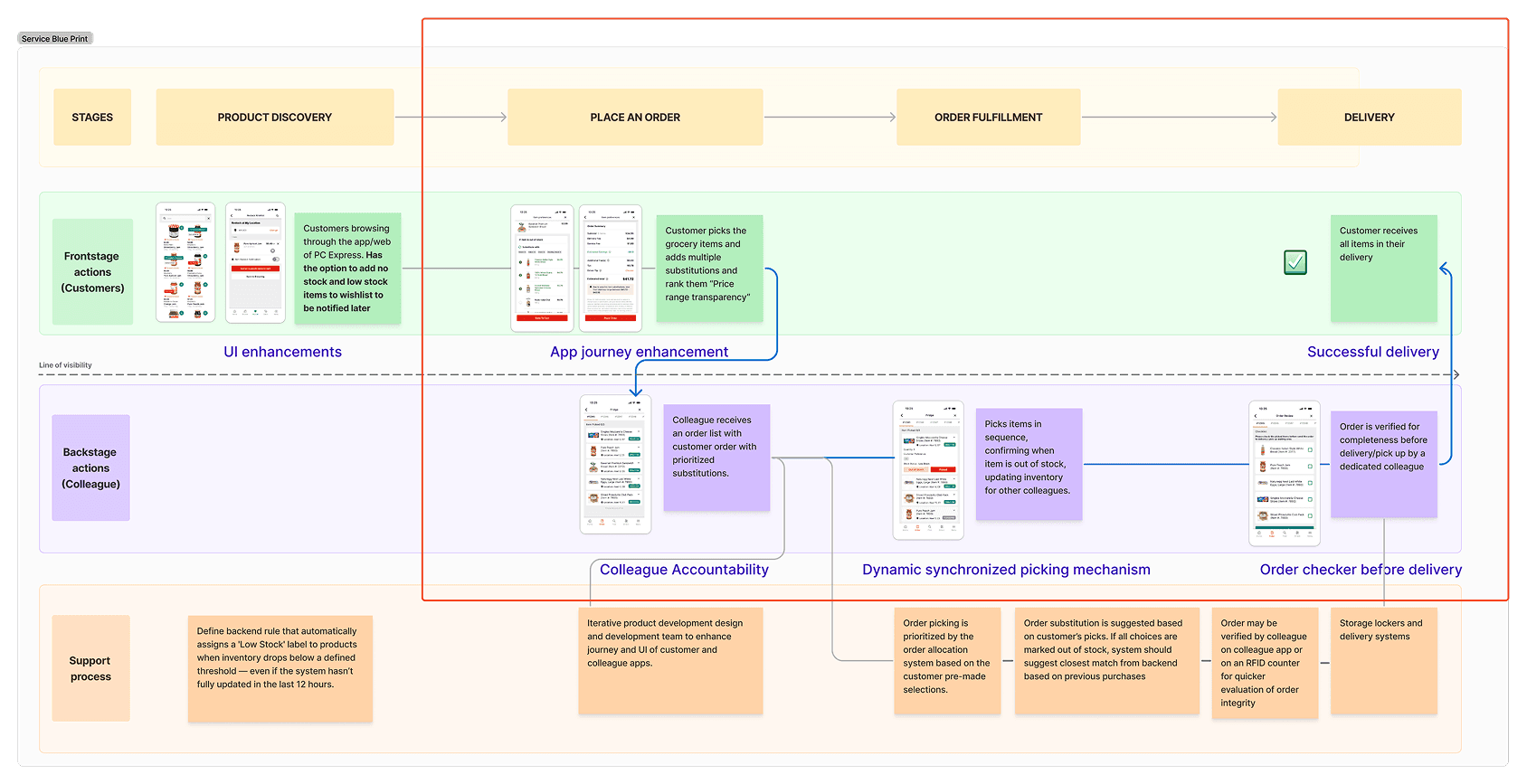
These optimizations were designed as a connected system, not isolated fixes. Each improvement links customer expectations with colleague responsibilities, ensuring that transparency at the interface leads to accountability in execution.
By aligning substitutions, pricing clarity, picking workflows, and final order checks, we created a more predictable experience for customers and clearer decision-making for colleagues—building trust through consistency rather than assumption.